Properties of hierarchical events in the Humboldt Extension for Ecological Inventories
Properties of hierarchical events in the Humboldt Extension for Ecological Inventories
- Title
- Properties of hierarchical events in the Humboldt Extension for Ecological Inventories
- Date version issued
- 2026-10-13
- Date created
- 2024-02-28
- Part of TDWG Standard
- http://www.tdwg.org/standards/450
- This version
- http://rs.tdwg.org/dwc/doc/hierarchy/2026-10-13
- Latest version
- http://rs.tdwg.org/dwc/doc/hierarchy/
- Previous version
- http://rs.tdwg.org/dwc/doc/hierarchy/2024-02-28
- Abstract
- Ecological inventories in the context of Darwin Core can be considered as types of dwc:Events with the potential for hierarchical structure relating broader parent dwc:Events with narrower child dwc:Events. Many terms originating in the Humboldt Extension are properties of eco:Survey; other terms describe resources related to surveys, such as eco:SurveyTarget. This document explains how dwc:Event hierarchies for ecological inventories should be structured and provides guidance on the use of Humboldt Extension terms in the context of parent and child dwc:Events.
- Contributors
- Yi-Ming Gan (Royal Belgian Institute of Natural Sciences), Wesley M. Hochachka (Cornell Lab of Ornithology), John Wieczorek (Rauthiflor LLC, Global Biodiversity Information Facility), Yanina V. Sica (Yale University), Peter Brenton (Atlas of Living Australia, CSIRO), Robert D. Stevenson (Department of Biology, University of Massachusetts Boston), Anahita J. N. Kazem (German Centre for Integrative Biodiversity Research, Leipzig and Friedrich Schiller University, Jena), Steven J. Baskauf (Vanderbilt University Libraries), Zachary R. Kachian (Keller Science Action Center, Field Museum of Natural History), Kate Ingenloff (Global Biodiversity Information Facility (GBIF))
- Creator
- TDWG Humboldt Extension Task Group
- Bibliographic citation
- TDWG Humboldt Extension Task Group. 2026. Properties of hierarchical events in the Humboldt Extension for Ecological Inventories. Biodiversity Information Standards (TDWG). http://rs.tdwg.org/dwc/doc/hierarchy/2026-10-13
1 Introduction (non-normative)
1.1 Status of the content of this document
Section 3 of this document is normative, serving as official guidelines in application of the Humboldt Extension. The other sections are non-normative and designed to help improve overall understanding in application and interpretation of the Extension.
1.2 RFC 2119 keywords
The key words “MUST”, “MUST NOT”, “REQUIRED”, “SHALL”, “SHALL NOT”, “SHOULD”, “SHOULD NOT”, “RECOMMENDED”, “MAY”, and “OPTIONAL” in this document are to be interpreted as described in BCP 14 [RFC2119] [RFC8174] when, and only when, they are written in capitals (as shown here).
1.3 Namespaces and terminology
The namespace eco: abbreviates terms minted for the purpose of supporting ecological inventories (http://rs.tdwg.org/eco/terms/). dwc: abbreviates terms from the main Darwin Core vocabulary namespace (http://rs.tdwg.org/dwc/terms/). All of these terms are part of the Darwin Core standard.
Text in code markup represents namespace prefixes, qualified names (QNames) for terms, or literal values. The word “organism” is used colloquially and is not used in the technical sense of the dwc:Organism class, unless specifically presented as “dwc:Organism.” The word “Event” is used in the technical sense of the dwc:Event class. An eco:Survey is a type of dwc:Event intentionally designed to characterize a defined biotic target or domain so that the resulting dwc:Occurrences can be interpreted collectively to support ecological and monitoring inference.
1.4 Intended audience and use for this document
The information in this document is targeted at data providers, data aggregators, and data consumers. Data providers are the individuals responsible for mapping ecological inventory data either into an Event-based Darwin Core Archive format that includes the Humboldt Extension or into Darwin Core Data Packages with eco:Survey records. Data aggregators and data consumers can use this document to better understand the data shared by data providers, specifically with respect to the relationships between hierarchical dwc:Event levels and when it is or is not appropriate to make inferences about attributes such as abundance or absence of detection.
2 Rationale (non-normative)
Ecological inventories in the context of Darwin Core can be considered as types of dwc:Events — they are actions that occur at specific locations over defined periods of time. Many terms originating in the Humboldt Extension are properties of eco:Survey; other terms describe resources related to surveys, such as eco:SurveyTarget.
There are many types of ecological inventory, ranging from singular observations of individual taxa (1 event:1 observation; Example 1 in Figure 1) to highly structured and deeply nested observations within other observations (e.g., 1 event:2 sub-events, each sub-event:2 sub-sub-events; Example 4 in Figure 1). The need for guidance on how to capture the details of nested observations (dwc:Event hierarchies) is the rationale for this document. Nested sampling designs can be translated into a relational database schema of parent-child dwc:Event relationships (a parent event with one or more child sub-events; Figure 1). This document describes the circumstances under which specific properties of parent and child dwc:Events SHOULD be populated based on the parent-child relationship.
When hierarchical surveys are represented using Darwin Core Archive, the representation does not follow a normalized database structure. Whilst a (relational) database would store information in multiple tables to avoid repetition of key information, datasets shared using the Darwin Core archive format and the Humboldt Extension instead use a “flattened” structure. In order to share inventory data such that no information is lost and no information is incorrectly inferred, one SHOULD report all information at all applicable levels. The rules for applicability and how to populate terms at parent and child levels in the dwc:Event hierarchy are captured in section 3.2 Guiding principles and in section 3.3 Implementation principles.
Darwin Core Data Package provides a relational representation in which eco:Survey, its contextual dwc:Event, survey targets, and related resources can be represented in separate related tables.
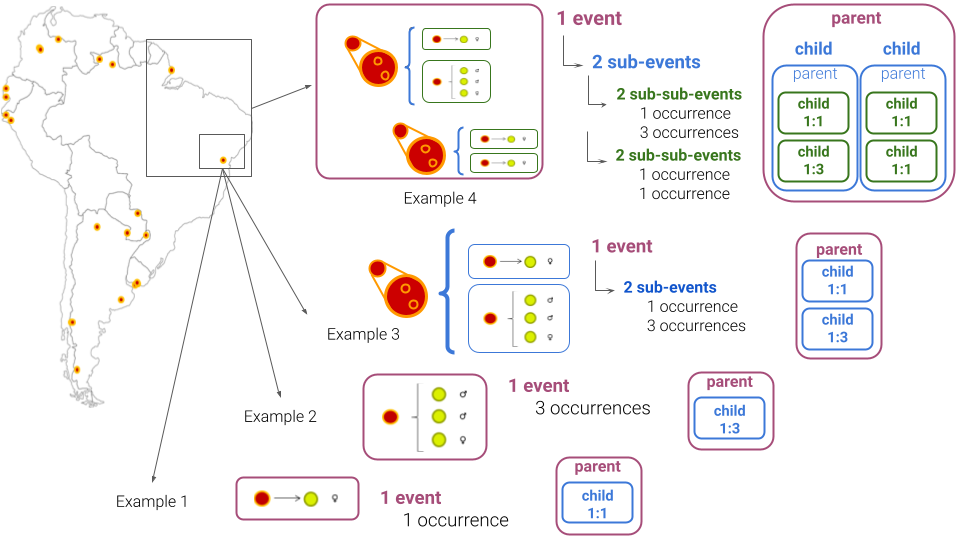
Figure 1. Visual representation of an ecological inventory illustrating four examples of occurrence data associated with dwc:Events nested within parent dwc:Events, at varying levels of complexity ranging from low (Example 1) to high (Example 4).
3 Usage guidelines (normative)
3.1 Definitions
Inventory dataset - An inventory (dataset) consists of one or more dwc:Events that MAY be related to each other in a hierarchy of parent and child dwc:Events. This is not new to the capabilities or intentions of Darwin Core.
Inventory hierarchy - A set of related dwc:Events, in which a narrower dwc:Event (child) points to the related broader dwc:Event (parent) via the child’s dwc:parentEventID. A higher-level dwc:Event might contain information about the inventory design that applies to all of its children.
Parent dwc:Event - A parent dwc:Event is any dwc:Event whose dwc:eventID is a dwc:parentEventID for at least one other dwc:Event (e.g. EVENT_01 in Figure 2).
Child dwc:Event - A child dwc:Event is any dwc:Event whose dwc:parentEventID is populated with the dwc:eventID of another dwc:Event (e.g. EVENT_02 or EVENT_03 in Figure 2).
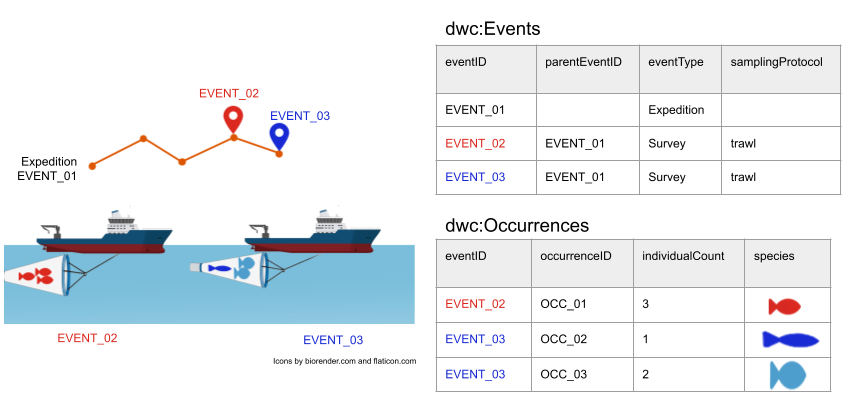
Figure 2. Visual representation of an inventory hierarchy illustrating parent-child dwc:Event relations. The higher-level (parent) dwc:Event, EVENT_01, may include general information about the inventory design. Species occurrences are captured for two child dwc:Events (EVENT_02 and EVENT_03).
3.2 Guiding principles
3.2.1 Principle of spatiotemporal coverage
A parent dwc:Event MUST encompass its child dwc:Events spatially and temporally. Specifically, the spatial extent and temporal interval of a parent dwc:Event MUST contain the spatial extents and temporal intervals of all of its children. For example, if child dwc:Events took place in various locations throughout, and only within, Burundi, then the spatial extent of the parent dwc:Event would be Burundi. Similarly, if the child dwc:Events took place periodically throughout the year 2019, the temporal interval of the parent dwc:Event would begin when the earliest child dwc:Event began and end when the latest child dwc:Event ended.
3.2.2 Principle of applicability
Terms that are properties of an eco:Survey SHOULD be populated explicitly at every level in the dwc:Event hierarchy to which they directly apply. The value of a property for any dwc:Event SHOULD be populated for the Event itself rather than merely summarized in a higher-level dwc:Event. For example, a child eco:Survey (C) with multiple dwc:Occurrences, some of which resulted in voucher specimens, SHOULD possess a value of true for the term eco:hasVouchers. The data user SHOULD NOT be expected to look at the eco:hasVouchers term for the parent eco:Survey (P) of C in order to find the value.
If a term genuinely applies at multiple levels of a dwc:Event hierarchy, values SHOULD be reported explicitly at each of those levels. The values for child dwc:Events might be the same as their parental values, or child dwc:Events might possess their own more specific values. This principle allows child dwc:Events to be “autonomous” to the greatest degree possible, and avoids uncertainty about where to look for the values of properties of any given dwc:Event.
3.2.3 Principle of non-derivation
As a complement to the Principle of applicability, properties of an eco:Survey SHOULD NOT be populated for a parent eco:Survey by deriving or summarizing information from child dwc:Events. If a property does not directly apply to a given level of dwc:Event (i.e., it is not an actual property of that dwc:Event), it SHOULD NOT be populated with a value. For example, if the parent eco:Survey P from the example in section 3.2.2 above is not directly linked to dwc:Occurrences, then the term eco:hasVouchers does not apply at that eco:Survey level and SHOULD be left unpopulated. Stated generally, data providers SHOULD NOT construct a value for a parent dwc:Event from values at the level of child dwc:Events.
In some cases, including the example above, it would not be valid to derive or summarize information from child dwc:Events to populate a parent dwc:Event. Suppose parent dwc:Event P has two child dwc:Events, one with eco:hasVouchers true and one with eco:hasVouchers false. The value of eco:hasVouchers for P cannot be derived or summarized from its children, as it is neither true nor false for all of them (the only two values consistent with the recommended controlled vocabulary for the term). It would be neither desirable nor reliable to use the values of the child dwc:Events to infer a value for the parent dwc:Event. The Principle of inference (below) provides a further example, where scope terms of parent dwc:Events MUST NOT be populated by summarizing from lower levels (either through the scope values of child dwc:Events or, for example, through taxa detected in child dwc:Events).
There are terms which could theoretically be populated for a parent dwc:Event from the primary data already provided for that dwc:Event's children (e.g., eco:materialSampleTypes). Populating the parent term could facilitate the discovery of higher-level dwc:Events among whose children there is a particular value of a property (e.g., a search through the highest-level dwc:Events in datasets to find datasets in which there are particular eco:materialSampleTypes). However, providing such summary values is specifically NOT RECOMMENDED. Doing so a) adds no information to the dataset (the summary information is already available by inspecting the primary data in the dwc:Events in the dataset), b) adds an extra burden of summary upon the data provider, and c) is susceptible to errors (ambiguities, inconsistencies, incompleteness) when trying to construct secondary summary information for higher-level Events.
3.2.4 Principle of inference
Certain terms in the Humboldt Extension support inferences. Examples of terms that help data users to determine whether or not inferences can be made include those describing the scope of the inventory, such as eco:targetTaxonomicScope and eco:excludedTaxonomicScope, and terms describing completeness, such as eco:taxonCompletenessReported, eco:taxonCompletenessProtocols and eco:isTaxonomicScopeFullyReported. The values of these terms in an eco:Survey have implications for the interpretation of all of that eco:Survey’s child dwc:Events. These terms MUST be populated for the highest-level eco:Survey to which they apply and for every descendant eco:Survey in its dwc:Event hierarchy to which the same scope or completeness statement applies.
The scope terms of an eco:Survey MUST be populated whenever the scope was in effect. Having this information in an eco:Survey is the only way to be able to infer absences of detection within that eco:Survey, whenever the dwc:Occurrences linked to that eco:Survey do not explicitly state zero counts or when there are no dwc:Occurrence records for a given taxon that fell within the taxonomic scope (the combination of eco:targetTaxonomicScope and eco:excludedTaxonomicScope). The ability to “implicitly” support inferences about undetected dwc:Taxon targets (and other organismal targets) was a high priority objective in the design and structure of the Humboldt Extension. By “implicitly support inferences” we mean that a dwc:organismQuantity of zero individuals within a particular scope does not need to be provided explicitly as a separate dwc:Occurrence record, for an eco:Survey that does declare an encompassing scope and where all the taxa/targets that were detected were fully reported. Instead, those zero counts can be reconstituted by data users based on the data contained in other terms. When the target taxonomic scope (the combination of eco:targetTaxonomicScope and eco:excludedTaxonomicScope) is determined in advance of inventory data collection, and eco:isTaxonomicScopeFullyReported = true, then any dwc:Taxon that falls within the taxonomic scope but is not reported in the dwc:Occurrences of any child dwc:Events can be inferred to have dwc:Occurrences with a dwc:organismQuantity of zero (i.e., undetected dwc:Organisms of a given dwc:Taxon).
These inferred zero counts, in combination with information about sampling effort (i.e., eco:samplingEffortProtocol, eco:samplingEffortValue and eco:samplingEffortUnit), can then be used to estimate the likelihood that a count of zero organisms represents a true absence of dwc:Organisms belonging to a dwc:Taxon. However, if eco:taxonCompletenessReported = reported incomplete and/or eco:isTaxonomicScopeFullyReported = false for an eco:Survey, then future users SHOULD NOT make assumptions about absences.
Data providers MUST NOT retrospectively infer and populate eco:targetTaxonomicScope, or other scope terms, for inclusion in a dataset shared with the Humboldt Extension. This is a further example of the Principle of non-derivation (3.2.3). Likewise, data users SHOULD NOT assume or reconstruct a scope that was not explicitly given by the data provider. There are at least two reasons for this: (1) Artificial construction of scope: retrospective inference of target scope by a data provider by aggregating information across all child dwc:Events may result in a reported scope that is narrower than the actual intended scope of the inventory. (2) Artificial broadening of scope: it is possible that the inferred scope can be described in multiple ways. For example, the scope of a list of species within a single genus could be described as the genus, as the family containing that genus, or as an even broader taxonomic concept. Thus, unless the true taxonomic scope is a known variable in the inventory protocol, then a presumed scope may be too broad or too narrow, leading to errors when inferring counts of zero.
3.3 Implementation principles
-
A Darwin Core-based inventory dataset MUST consist of at least one
dwc:Eventrecord. -
Each
dwc:Eventin an inventory dataset MUST have a non-empty value fordwc:eventIDthat is unique within the dataset. More benefits are realizable if thedwc:eventIDs are also globally unique. -
Information associated with an
eco:SurveyMUST be explicitly related to the correspondingdwc:Event. In a Darwin Core Archive using the Humboldt Extension, the association MUST be made by using the samedwc:eventIDin the Event and extension records. In a Darwin Core Data Package, the association MUST be made using the relationship defined by the applicable table schemas. It is permissible to havedwc:Eventrecords without associated Humboldt Extension records. -
An inventory hierarchy MUST be realized by explicitly relating each child
dwc:Eventto a parentdwc:Eventthrough the childdwc:Event’sdwc:parentEventID. -
Data providers SHOULD follow Darwin Core principle 4, which is to fill the values of as many terms as possible, subject to the Principle of applicability and the Principle of non-derivation (sections 3.2.2 and 3.2.3, respectively).
-
A child
dwc:EventMUST NOT be assumed to implicitly “inherit” the value of any property of any of its parentdwc:Events; rather, the value SHOULD be provided explicitly as discussed in section 3.2.2 Principle of applicability. -
A parent
dwc:Eventproperty SHOULD NOT be populated by deriving or summarizing information from childdwc:Events; rather, the value SHOULD be provided explicitly if appropriate to the nature and level of thedwc:Event, as discussed in section 3.2.3 Principle of non-derivation.
4 Examples (non-normative)
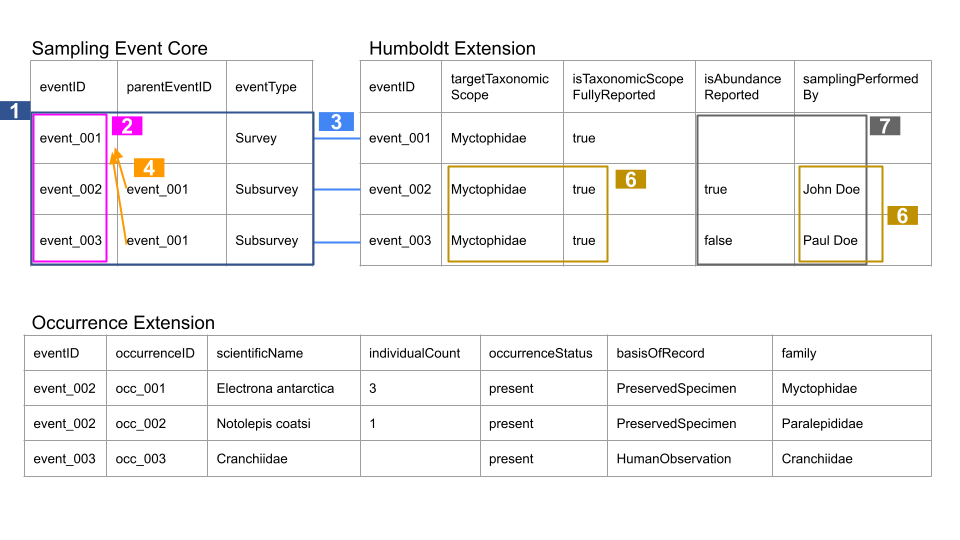
Figure 3. Example illustrating the Implementation principles. Numbering of colored rectangles indicates the relevant principle; lines, arrows or rectangles in the same color indicate that the cells, columns or records are affected by the principle. Notolepis coatsi and Cranchiidae are not within the reported eco:targetTaxonomicScope. Principle 1 - an inventory dataset must have at least one dwc:Event record; here, 3 records can be identified. Principle 2 - each dwc:Event record must have a unique dwc:eventID. Principle 3 - in the Darwin Core Archive representation illustrated here, Humboldt Extension records must be linked to the core dwc:Events via shared dwc:eventIDs. Principle 4 - every child dwc:Event must be related to its parent dwc:Event through a dwc:parentEventID. Principle 5 - term values for dwc:Events should be populated whenever possible; in the figure all records follow Darwin Core principle 4, subject to the Principle of applicability and the Principle of non-derivation. Principle 6 - terms for child dwc:Events must be explicitly populated rather than “inheriting” values from their parent dwc:Events. Principle 7 - terms for parent dwc:Events should be populated whenever relevant, but not be derived or summarized from their child dwc:Events.